

carpepecheur
-
Posts
333 -
Joined
-
Last visited
-
Days Won
31
Content Type
Profiles
Forums
Gallery
Blogs
Events
Articles
Everything posted by carpepecheur
-
Download a free program called Irfanview Link . Import photo, select Image/Resize set width to 800 pixels (or any other size you want) and save it. It does much much more. I have been using it for many years.
-
It was a beautiful warm spring day today and me and my dog were doing a recce of a lake I have not fished before. It was 2 Km long and completely surrounded by dense forest. On one side was a narrow twisty but pretty walk that had been made through the undergrowth. After about half an hour I heard an irritatingly loud radio blasting out pop music. I came across two lads carp fishing. They had a mountain of gear and looked the part so I stopped for a chat. They had not had a single bite. They blamed the bright sun, the lack of wind, the time of year, their bait etc. etc. I said I did a bit of carp fishing and could offer some advice that might help. “OK” they said. “Carp really don’t like pop music” I suggested They looked at each other as if I were insane so I wished them luck and started to leave. “They prefer classical music” I said sarcastically as I continued on our walk. When I returned a little later, surely enough the radio was no longer belting out pop music. They had retuned to a classical station and was belting that out at an even higher volume.
-
- 2
-

-
new byte alarms over engineered hype
carpepecheur replied to oscsha's topic in Carp Fishing Tackle and Equipment
Sorry Yonny but he's been castrated. -
new byte alarms over engineered hype
carpepecheur replied to oscsha's topic in Carp Fishing Tackle and Equipment
OK that makes sense. Want to borrow my dog? -
new byte alarms over engineered hype
carpepecheur replied to oscsha's topic in Carp Fishing Tackle and Equipment
If you are using a fixed lead (as opposed to a running rig). surely there are only two possible outcomes - a toner or a drop back, neither of which warrant a sensitive alarm. OR - and perhaps this is where I am missing the point - are you saying that the alarms are so sensitive they can detect movement of the bait even if the lead does not move? -
new byte alarms over engineered hype
carpepecheur replied to oscsha's topic in Carp Fishing Tackle and Equipment
In this situation are you using a fixed (or semi fixed lead as some people call it)? -
new byte alarms over engineered hype
carpepecheur replied to oscsha's topic in Carp Fishing Tackle and Equipment
I get the bit about pike fishing. I guess my fishing style does not warrant an expensive alarm so I will stick to my cheapo Chinese alarms at around a fiver each. My best bite alarm ever is my dog. He lays and watches my rods all day long. Long before I am aware of a bite he jumps up and stares at the rod tip. If I am distracted and do not react, he starts barking. -
new byte alarms over engineered hype
carpepecheur replied to oscsha's topic in Carp Fishing Tackle and Equipment
If I need to use an alarm, I am probably fishing with very tight lines – bolt lead style. I am curious to know how people make use of the extra sensitivity of expensive alarms. -
It is the usual case of jumping to the wrong conclusion. A friend of mine was about to retire abroad but his family had a history of cancer. He consulted a WHO report which listed the countries with the lowest death from cancer, Sure enough there was one country that stood out as having the lowest death rate from cancer. ------- Syria!
-
I couldn’t agree more Yonny. The mistake some people make is that they attribute what they are observing to the fact that the carp DETECT a change in pressure and ACT accordingly. For example I have heard some people say fish rise to the surface in high pressure to relieve the uncomfortable pressure it has on their swim bladders. Or during low pressure they drop to the bottom and start feeding there. They may be observing a valid correlation but they are mistaking the cause. If you start basing your observations on incorrect assumptions then you run the risk of going in the wrong direction to further your knowledge. It is important to understand the difference between atmospheric pressure and hydrostatic pressure. Atmospheric pressure is the pressure you and I experience in the air at the bankside. Hydrostatic pressure is the pressure experienced by a fish under the surface of the water. There is a connection between the two but it is not a direct correlation. In other words 1 mbar increase in atmospheric pressure does not result in 1 mbar increase in hydrostatic pressure. There is an increase in the latter but it is much smaller. The difference arises from the fact that air is a compressible fluid and water is an incompressible fluid. So how much does pressure change during a storm? Well obviously it varies greatly depending on many variables but we need something to work with. Looking at a world meteorological forecast at the time of writing, the highest pressure I can see is 1025 Mbar and the lowest 975 Mbar so I guess that represents a fairly extreme weather pattern that we are unlikely to experience in UK. Just for information, on the same day in the UK the highest pressure is 777 Mbar and the lowest is 768Mbar. I am not being too precise here I am just trying to get a ball park figure for the highest change of pressure we can expect in a storm which seems to be around 50 Mbar. Using very simple physics, If there was no atmospheric pressure, the hydrostatic pressure on the surface of a lake would equal 0 At 0.5 metres depth the hydrostatic pressure would be 49.05 Mbar. But we have to add the atmospheric pressure to those values which is changing with the weather. And that change, in very extreme conditions, can be as much as 50 Mbar That means that under extreme conditions the atmospheric change above the surface only represents a hydrostatic change of 0.5 metres. Don’t take my figures, get your own from the weather forecast or from a barometer. Take the maximum and minimum values at your fishing location and then relate that difference to a difference in depth using 50 Mbar change in pressure = 0.5 metres in depth. (for Luddites still using imperial measures you can make your own conversion) So here is the whole deal. Whatever sensation a carp experiences from a change in pressure due to weather e.g. 50 Mbar it is EXACTLY THE SAME as the sensation it would experience by changing the depth at which it swims by 0.5 metres. But that is not all. That change does not take place instantly. It can take several hours for a weather front to move over your location so the actual change in sensation the fish experiences takes place VERY gradually. This means that even if the carp is ultra-sensitive to pressure change it only has to adjust its depth by a very small amount to compensate for that change. The reason that we attribute change In behaviour in how a carp behaves as a result of changing pressure is NOT because it experiences it directly but as a result of other factors that also change with pressure which may be temperature, wind strength, lighting conditions etc etc. Only by understanding this can you develop a true understanding of what is affecting the carp. Pressure change is universal in a given region but temperature, wind, light etc. etc. may vary more locally from lake to lake and even swim to swim. Of course if you fail to catch fish by not understanding this you can always blame your failure on the pressure change which you can do nothing about.
-
I have had my best results in settled high pressure, with clear blue skies, and bright sunshine. ---- But I live in SW France and that is typical summer weather here!
-
It is not that dangerous. The hunters are required by law to wear orange caps and jackets (to prevent them shooting each other). Also they are required to put up signs on the nearest public roads. I have been put in much more serious danger by cyclists.

-
Turns out you were nearer the mark than you think Crusian. The lake is in thick woods on the side of a long valley. In the bottom of the valley is a narrow strip of pasture land. The other side of that is a track and open unfenced woodland. The French hunters spread out in a line along the track while their dogs flush out game from the woods behind onto the open pasture land where they can be shot. I am not talking shotguns for pheasants etc. They are using proper rifles for wild boar and deer. I can't call out and let them know I am directly behind their target because I am not supposed to be there.
-
new byte alarms over engineered hype
carpepecheur replied to oscsha's topic in Carp Fishing Tackle and Equipment
Exactly. He uses nearly 100 words to say that low frequencies penetrate better than high frequencies. -
Hi and welcome EW. I thought you might get more response to your query. I use conventional and telescopic rods. The latter have improved in quality over the years but seem more popular on the continent. My only complaint is that they can twist in use so the eyes are not aligned but if they are used intelligently this is a trivial problem. There is a third option and that is the traveller style rod. Here is a link to an example. It all packs down to just under 1 metre . traveller style rod
-
-
I think I must beg to differ Oscha. Technology does not affect angling ability. For example a Deeper cannot tell you whether a lump on a flat lake bed is a carp or a kitchen sink. Only your experience can tell you it is not likely to be a kitchen sink.
-
Absolutely, there is no substitute for time spent on the water
-
When I started fishing, I used a homemade brass centre pin reel. Now I use a fixed spool which is a masterpiece of precision engineering constructed completely automatically using the latest robotic technology. My first rod was handmade from a tank aerial and wooden handle turned on a lathe. Now I use a high tensile, featherweight, carbon fibre rod developed using the latest aircraft construction technology. When I went night fishing I sat up all night in a deck chair with my finger on the line to feel for a bite. Now I lay on my comfortable folding bed chair wrapped in a four seasons sleeping bag in a waterproof and insect proof bivvy waiting for the receiver on my high tech bite alarm developed from research into the space program to tell me which pre programmed, colour coded, tone was indicating a bite on which rod. To measure depth, I used to use a plummet (lead with cork insert). Now I use an echo sounder, first patented in 1913 and now with the paper graph replaced by a screen and the results recorded on a microchip and everything miniaturised. All of the above progress made my fishing easier and more comfortable. NONE of them put a fish on the hook. As they say "nostalgia is not what it used to be"
-
The innocently smiling emoji was meant to suggest I was only gently teasing Highy, after reading another thread. I still love using my Mk IV although it is way past its sell by date so understand exactly what you mean. The old ways are often the most enjoyable. £150 ? Some people pay that for a single high tech bite alarm.
-
I find a Deeper much easier than thrashing around with a marker float.
-
The marketeer who coined the phrase "fish finder" must be laughing all the way to the bank. A Deeper cannot differentiate a fish from a kitchen sink. OK there aren't too many kitchen sinks in a lake but there are plenty of gas bubbles, loose bits of weed or general detritus floating around all of which give a reflection to the pulse generated by the transducer. If you could be sure it was a fish, it would only tell you where it had been and not where it would be when you are fishing. You would not be able to tell if it was a carp or a bream. Carp are sensitive to vibration so you may have already scared them off. Switch on your Deeper by dipping it in water and listen to the noise it makes. A Deeper is a good tool for measuring depths very quickly and can replace hours of thrashing around with a marker float. More important for me is it can locate underwater obstructions such as an area of submerged fallen trees which could be a hazard to landing a fish or which could provide a holding area. It is nothing more than a useful tool that requires experience to get the most benefit from it.
-
Some further thoughts on the use of salt
carpepecheur replied to carpepecheur's topic in UK Bait and Bait Making
Yes, I agree Yonny. It was only an indication and best I could do at the time. What was interesting was that with just a tiny prick of a hole in the bag, it collapsed almost immediately. Did you notice the wave of salt solution wash around the bottom of the tank? The undissolved (presumably due to contact with salt) remains of the bag floated to the top. The only scientific method I can think of is to use salinity metres in a real lake and actually measure this in a real situation. Unfortunately, now that I have retired, I no longer have access to such equipment. My experience is that when you are able to make precise measurements the results do not always agree with theory. Despite everyone telling me it was impossible, I once proved that Brighton goes up and down with the tide. -
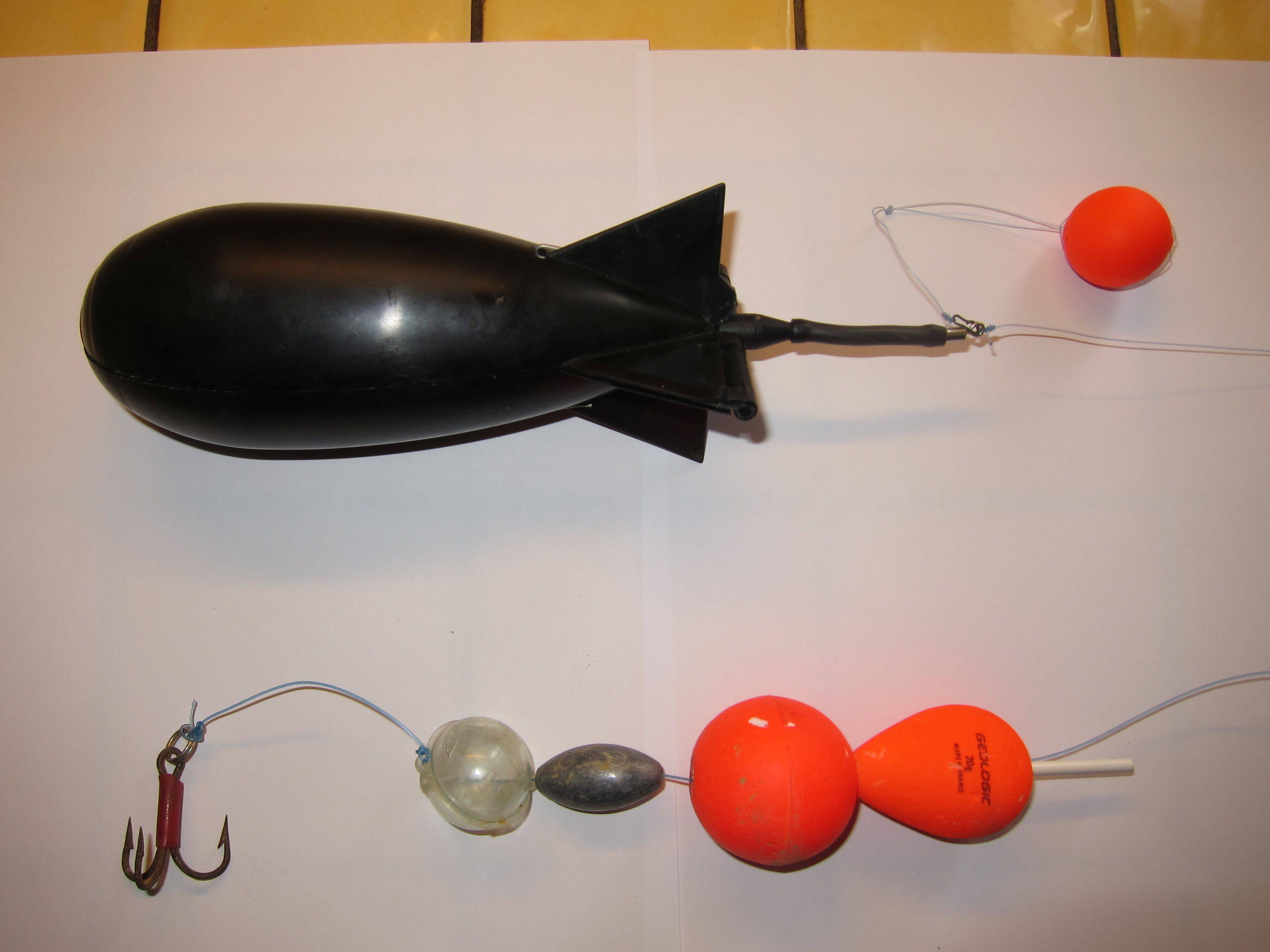
I have had crack offs with both Spombs and a Deeper but have never lost one yet. I tie a small hi vis float to the Spomb or Deeper with a length of light line. In the event of a crack off, the small float drifts behind the lost Spomb or Deeper and makes it easy to see at a distance. I then cast a retriever over it. This is just a heavy floating object which trails a large treble hook. This picks up the line between float and spomb and retrieves it easily. I have a photo of one I made earlier. The Deeper is an incredible piece of kit. As professional surveyor (retired) I do not consider myself a noddy for simply using the tools of my trade. I do not rely on it. It simply expands my experience.
-
Some further thoughts on the use of salt
carpepecheur replied to carpepecheur's topic in UK Bait and Bait Making
I repeated the earlier experiment with some water disturbance as Yonny suggested. This time I pricked a tiny hole in the bag to help it dissolve quicker. I first tried to simulate a carp thrashing around then I introduced some undertow. I have a clock at the side so you can see where I have speeded the footage up. There is a very faint colouring in the upper layers but most of it stays near the bottom althought not as concentrated as the earlier test.