

carpepecheur
-
Posts
333 -
Joined
-
Last visited
-
Days Won
31
Content Type
Profiles
Forums
Gallery
Blogs
Events
Articles
Everything posted by carpepecheur
-
I bought one of the very first Deeper sounders as soon as they became available. I have to say it is a miracle of technology and have been very happy with it. Now the GPS does not work and I can only use it in “boat” mode using my phone’s GPS for position. I want to buy a new one but see that now there are a lot of options (with prices to match). I understand the science between different frequencies and I understand the CHIRP technology. However, I cannot find my way past the marketing speak on their web site. It seems to infer that you can use all three frequencies using CHIRP technology. Surely it cannot scan all three frequencies in one pulse? It would make the pulse far too long. So am I right in thinking you have to select which frequency you want to use (100, 240, or 675). If this is the case does the CHIRP technology work on each of these three frequencies? And, for the frequency it works on, what is the range of frequencies in the pulse? This might be listed in the manual under specifications. If anyone has used one of these new versions, it would be interesting to hear if it makes much difference in normal fishing situations.
-
I have no experience of this drone but the two features that caught my eye were the 1 inch sensor on the camera and absence of geofencing.
-
Float fishing has brought back a lot of enjoyment to my carp fishing. You have to actually fish all the time rather than waiting for something to happen (if that makes sense?) I always go for the lift method with homemade porcupine quill and a single shot of the appropriate weight for conditions. I usually fish in 5 to 7 metres of water so I leave the float free to slide up to a knot of marker line set at the relevant depth. In answer to the op I think no hook link is needed and 30 grams is way over the top. I strike to set the hook rather than rely on a bolt effect.
-
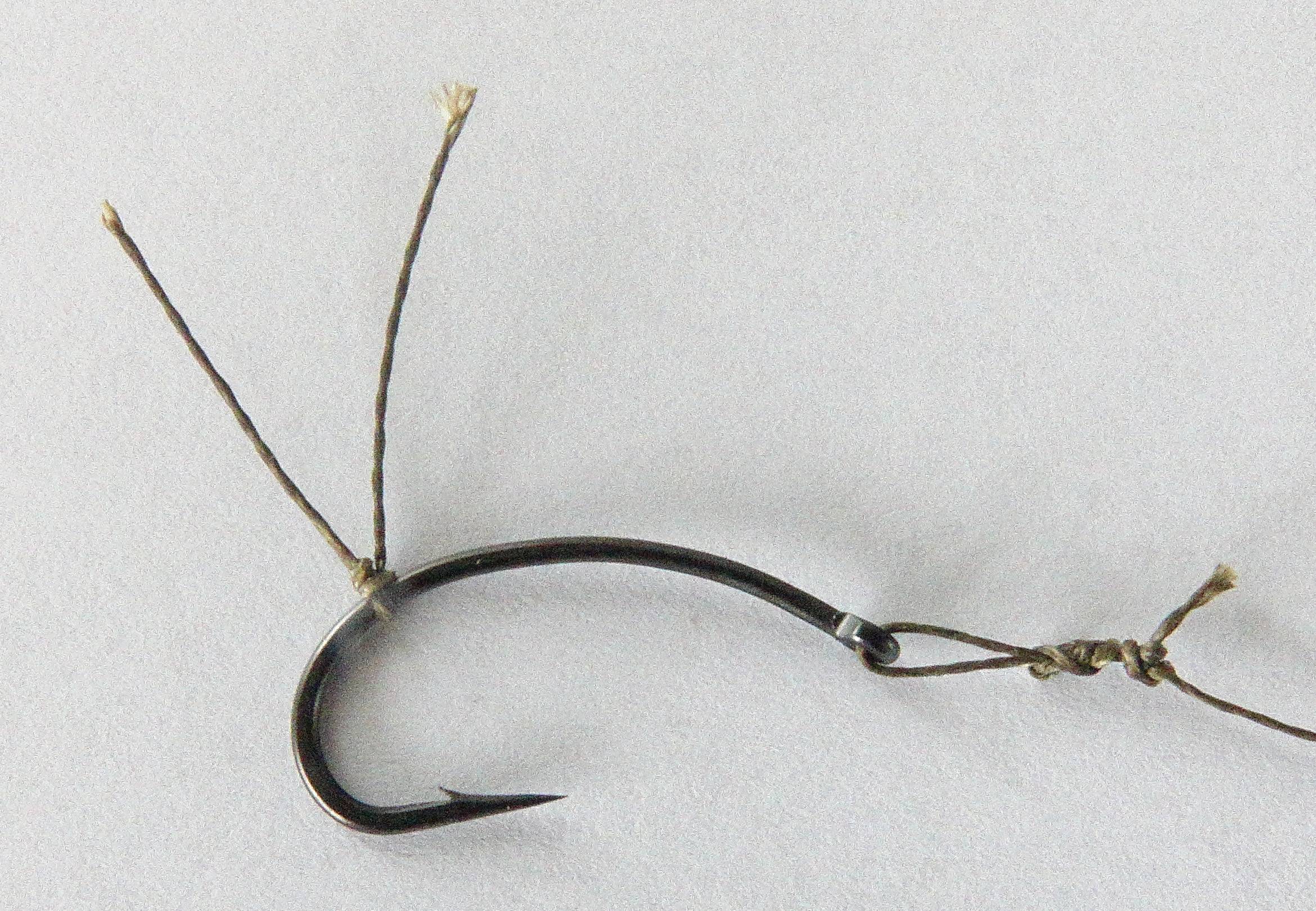
I totally agree with the approach of testing the rig against another that you have confidence in. I am extremely lucky in that I have sole access to a locked, disused gravel pit where I can guarantee a few low doubles in a short day session. That is how I gradually built up the confidence in the rig. The rig I described in the post is the most basic form but there are a large number of variations I have tried. Slipping on the line is one problem. Firstly, I rarely cast out if I am using a ledger style set up. I always use a bait boat even if I am only fishing a pub chuck away. If that is not possible I put my rig in a PVA bag to be sure that the presentation is not compromised when I do cast. However, you can put a float stop either side of the boilie to hold it in place. I more often than not use a floating plastic maize to stop the boilie slipping up the line (and also to help it sit on the bottom nicely). Another thing I have done is, when tying the hook, instead of trimming off the line left hanging, is to use it to tie a series of overhand knots up the line so you have a very long and ugly looking knot to the hook, then I jam the boilie over that knot. The question I find most difficult to answer is what type of knot to use. My original approach was to try and get the hook to push away from the boilie as it turns. I used a spade end knot tied to the shank of a hook passing through an out turned eye. The last cm or two was a coated braid stripped back to the flexible braid for the rest of the link. The problem with this is the direction the hook points, as it rotates, depends on the tension in the braid. I wanted the hook to rotate with the hook always pointing forward to find a good hook hold and this method did not give me control over that. My knot skills are very limited so I am not sure what is the best to use but it needs to connect to the eye in a loop. I use a tucked half-blood knot which is not pulled tight to the eye but stops in a loop. It is then locked by tying another tucked half-blood above it. This makes a very flexible connection between hook and line. I then tie a piece of thread onto the bend of the hook. The idea is that, as the hooks swings through its arc, that piece of line puts a slight drag on the back of the hook and turns the hook so that it is always leading with the point. I have taken a photo to try and demonstrate what I mean. Although I said that the rig was incredibly simple, it has had a lot of thought put into it.

-
Not at all - I never got that impression. All new idea benefit from serious scrutiny. I am hoping to benefit from the ideas of others. Yes I understand your thinking. Personally I would make the baits as nearly neutrally buoyant as possible. I do this by cutting a bottom boilie and a pop up in half and then threading the two together with the pop up half on top. If you then add more buoyancy at the hook end it could float up spoiling the action of the rig. However, i will have to test that in the tank.
-
-
Appreciate your interest. have a great holiday
-
No definitely use a separate hook link. You want a safe set up. I always use an inline lead on mainline with swivel at end of hooklink. I guess a stiff braid hooklink is OK but you definitely need a flexible line at the boilie end. It was not particularly designed as an anti-tangle rig. Personally, if I am casting I put the rig in a PVA bag (I have my own ideas about that too!). Where possible, I prefer to use a bait boat. I didn’t even know what a dumbell wafter was so had to google it. It looks OK. Definitely thread it on through its long axis. I have not found the need to put a stop above the boilie. I try to keep stuff as simple as possible but it should do no harm. You could also consider a floating maize instead of a stop. Good luck and let us know how you get on.
-
That is an excellent question emcee. No I do not mean hook pulls and I have not watched my rig enter a carp’s mouth. I have probably watched the same videos as you which is why I came up with the idea. I often use, what I refer to as, an “active lead” system. This is simply a collar mounted on the lead. I wind down and put a strong bend in the rod as the collar digs into the silt and the line is bowstring tight. The slightest movement of the bait dislodges the lead and the rod straightens. (I am sure I have posted this system on here before). If the rod straightens and I have no fish, I assume I have been “done”. Also, as previously mentioned, this year I have been float fishing a lot using the classic “lift” method. If I use the bald rig, the fish tears off straight away. If I use a typical hair, I do sometimes get a lift and return before I get a chance to strike. The same thing happens when using sweetcorn directly on the hook. From this evidence I surmise that the bald rig is better but I would be happy to listen to other ideas.
-
I can’t see that the rig is any less safe than a normal hair rig, however I have never had to deal with fishery owners so I would not comment on their prejudices. I also have no experience of so called “rig shy” fish. Salokcinnodrog made an interesting point about changing hair length to suit bottom conditions such as silt which set my grey cells rotating. I have a concern which I cannot find a way to test yet so I offer the following thought experiment. The problem, as I see it, when looking at explanations of how a rig works, is that it usually considered on its own in isolation from anything else that is happening in a carp’s mouth. A carp can only pick up a certain amount at any one time e.g. a mouthful equal to the volume of its buccal cavity. This will consist of water, silt, ground bait, freebies and hopefully your hook bait so how will this affect your rig? Just to keep the maths simple, imagine a cube of 27 boilies which equate to a single mouthful being sucked in. The top layer of 9 boilies will go well into the mouth. The second layer of 9 boilies are also comfortable inside the mouth. The bottom layer of 9 boilies will only just be inside the mouth. Now imagine each boilie is on a hair attached to a hook. The first two layers will be OK but the with the lower layer of 9 boilies the hook will never go inside the mouth so can never work. In other words you only have a 66% chance of the hair working. With the bald rig the hook turns above the boilie so you have a 100% chance of it working. Do the same with smaller boilies occupying the same volume. If you have a 4 X 4 X 4 pattern (64 boilie) using the same logic the hair rig will have a 75% chance of working (bald rig stays at 100%). So I would conclude the bigger the boilie, relative to the buccal cavity volume, the bigger the chance of a hair not working. OK that is an extremely hypothetical explanation but I think there may be SOME merit in the conclusion. When your bait is sucked up it is competing with all sorts of detritus to find room inside that cap's mouth. Please do give it a try Carpbell. I think it is good to have an enquiring mind and, as said before, let us know how you get on.
-
I have fished variations of this rig against traditional hair rigs and never had a hook hold outside the mouth in fact both methods hook just inside the mouth. I cannot remember any exceptions. The main difference is I get a few missed takes with a traditional hair but am hard pushed to remember any missed takes using this rig. Interesting comments, thanks for the feedback.
-
Could I just say something about testing rigs in general? I strongly recommend that you test your rigs in action by filming them being sucked up and then reviewing that action in slow motion or frame by frame. I forget who it was but I read that someone advocated putting a shot on the bend of the hook to get a better hooking action. The explanation for using it was pretty convincing. When I tested it myself I saw that as soon as the sucking stopped and there was no tension in the line, the hook just dropped down bend first with little chance of hooking anything. It is best not to take anybody’s word for anything without testing it yourself.
-
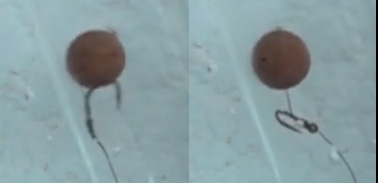
The hair has survived for 50 odd years so of course it works well. That does not mean it cannot be improved and I like to nudge all the odds gently in my favour. I did a lot of testing with the hair and found that the most important aspect for me IMHO is the position at which the hair comes off the shank of the hook. It needs to be just above the centre of gravity. Thus when being sucked in, and with the drag on the line, the point tucks under the boilie to make a smooth entry (and not hook outside of mouth). As soon as the line goes slack (when sucking movement stops), the hook drops down to an aggressive position. You can see this from screen shots taken from that video. IN OUT The drawback is that the whole of the boilie and the hook length must enter the mouth. Nine time out of ten this is not a problem. However, a carp can only take in one mouthful at a time and there must be times when the boilie does not fully enter the mouth in which case the hair rig will not work but the bald rig still has a chance. I am also convinced that the bald rig has a further advantage in that the sudden rotation movement makes the fish bolt straight away. Obviously I cannot prove this but all my takes using it are very fast. There are no casual nibbles as it were. I am enjoying float fishing at the moment using the classic lift method. If I am using the bald rig I get a very slight lift then the float disappears off to the horizon at speed. If I use a few grains of sweetcorn on the hook, I get the classic lift and have to strike the fish or risk losing it. I really do appreciate any input even if it is negative and I too am VERY interested in how others get on. When you have confidence in a rig it is extremely difficult to switch to a new method.
-
I used to call it The Spinner but then someone put a swivel on a hook and called that a spinner. Not sure what you mean by "going mainstream" I am only passing on my limited experience to anyone who might be interested. My carp fishing is quite a bit different from most on this forum. From personal tests I rate the hair 80 to 85% effective and the Bald Rig 98 to 99% effective. But that estimate is very subjective (and possibly biased) Would be interested how you get on. I would predict no missed takes.
-
Let us know how you get on. Yes a wafter is definitely best. The nearer you can get to neutral buoyancy the better IMHO. The rig started off as a pop up rig and evolved from there. The carp can only take one mouthful at a time so a wafter increases your chances of being included. With this rig it is still possible to hook a fish even if the boilie itself does not get past the lips. I do not think that would happen with a hair (especially a long hair as some people like to advocate using)
-
I may have posted older versions of this idea on here before. I have now got it down to an incredibly simple rig that anyone can tie. I have made a YouTube clip to try and explain my thinking. I apologise for the typeface used because it make L and i look the same but my font picker disappeared from the software I was using to make it. If it is still not clear how it works, simply place a cylinder (e.g.. a round cookie cutter) over the rig and gently lift the boilie. As the line tightens you will see what is happening. I may be simply re-inventing the wheel but have not found it described elsewhere.
-
2021 carp porter fat boy
carpepecheur replied to pablo7uk's topic in Carp Fishing Tackle and Equipment
-
That nice pad was 350 years old and needed a lot of work. Much smaller modern place now with definitely NO swimming pool to keep looking after. 🙂 Yes "tinker" is a good expression for me. I get a lot of stick and derision at some of my ideas but nevertheless have still appeared on Tomorrow's World and the Californian equivalent. I have posted my idea for the perfect carp rig with a boilie on the main line and no hair and been told a million reasons why it won't work. Meanwhile I continue to hit every bite. C'est la vie.
-
Nice shot. You get a different perspective from up there!
-
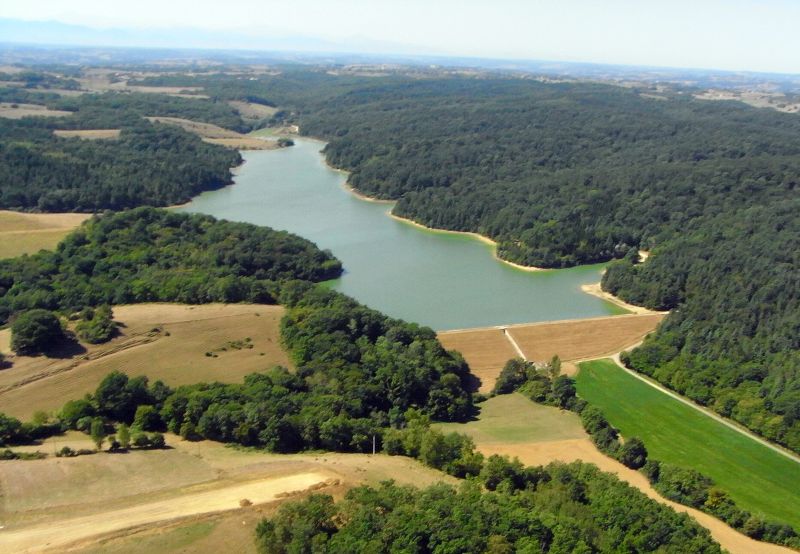
I apologise if I have posted some of this on here before but I thought you might like to see a little piece of recent aerial history. This is my very first aerial photo of one of the lake I fish. The shot was taken by a camera dangling below a kite. The camera was taking pictures by intervalometer and the direction was adjusted by radio control. To give an Idea of how this was done take a look at this (rather poor quality) you tube clip. I then spent a small fortune on one of the very first drones called a Mikrokopter. This had no GPS or stabilisation. You had to actually fly it by increasing and decreasing the speed of each motor. It was almost impossible to do that AND pay attention to what you were filming. Here is a clip of my very first video taken from my back yard. Eventually I bought a DJI Spark which I still use today although I would love to buy a new Mavic Mini 2. Even so it discovered my current favourite fishing spot which I keep entirely to myself. This last YouTube clip shows just how useful a drone can be.
-
Hours of fun and bitten fingernails ahead. Have fun. Could I suggest you take a look at Litchi software. It allows you to pre-program a route and take photos exactly where you want to. (although I have not kept up with DJI developments) It could be useful for your roofing excersise where you do not want to miss a shot. One other hopefully helpful suggestion - take a spotter with you especially early days. There's so much info coming at you it is easy to lose track of the drone.
-
Much safer than a pendulum cast 🙂
-
That's exactly what I do. I have been taking aerial photos for 15 years now. I started with a camera on a kite! Never had a test or license. It is just a case of being sensible. There aren't many drone police around (but there is always a "jobsworth" lurking). If I am going to have any people in my shots, I speak to them first and get their email address and promise to send them aerial photos of what they are doing. I have only ever had positive responses. All my neighbours have framed aerial photos of their house and there is even one of the town hall hanging behind the mayors desk (even though it is illegal to take shots within 50 metres of the place). If you have waves you will be unlikely to see much below the surface. Be careful with the return to home feature. The fail safe setting is when you hit "return to home", the drone goes up 30 metres (to avoid obstructions on return) , returns to just above the take off position, then descends. If you have launched from the bank from under trees it could cause a problem. You can change the settings. Practise practise practise before you go anywhere near water. Then, once you get out over the lake, it is squeaky bum time. However, apart from a one toner, it is about the most fun you can have outside.
-
Like Carpbell, I think a Deeper will give you far more information about your lake than a drone will. If you must use a drone you will need clear water, flat calm conditions and possibly a polaroid filter. If you are worried about landing on water which will definitely write off your drone, you could add some simple floats. I made a very amateur video of what I use on my ageing Spark when over a lake .
-